
Replace your AC and reduce your heating consumption by over 30%*
*in the room where it is located, and if your heating is controlled by a thermostat




*supply and shipping of faulty parts and circuit boards + access to repair tutorials.
Consuming just 5 to 48 watts to cool a space—in stark contrast to the 800 to 2,500 watts of a conventional air conditioner—Williwaw generates a powerful airflow, from a breeze to a storm, while remaining as quiet as possible.
It is the perfect eco-friendly ventilation for deep, peaceful sleep, even during heatwaves.
For example, in a 50m² room with a 3.5m ceiling height, the carbon impact footprint defined by ADEME is 79g CO2 per kWh.
Air conditioning | Williwaw | |
|---|---|---|
Purchase + installation costs | €6,350 | €1,898 |
Monthly electricity consumption | 9450 kWh | 14 kWh |
Monthly electricity cost | €1,323 | €2.02 |
Monthly carbon footprint | 7466 kg/CO2 | 11 kg/CO2 |
Total annual cost | €11,792 | €1,906 |
Annual carbon footprint | 66541 kg/CO2 | 137 kg/CO2 |
Over 2,000 Williwaw fans already sold. 5/5 rating across all reviews.
What a magnificent innovation by the ingenious Stéphane Thirouin, who designed Williwaw with equal parts style and technology.
A cool breeze in total silence and comfort thanks to its remote-adjustable thermostat, all while addressing the low energy consumption we all care about. The clever, playful assembly of this work of art even brings back fond childhood memories.
Jay Giulia (verified customer) – June 25, 2023
We suffered through the 2022 summer heatwave, and having the fan blowing its gentle breeze over our bed, in total silence, was perfect.
Its 5 to 10W consumption on the lower speeds is laughably low compared to air conditioning, for equivalent or even superior comfort (no cold shock).
Ultimately, we mostly use it in winter to circulate warm air in our living space. It remains difficult to quantify heating savings as everything depends on the thermostat setting, but the gain in comfort is real, with far less cold sensation around the feet.
As a bonus, we now use it during the off-season and winter to dry our laundry on the rack: after a 12-hour evening and night run at a relatively low speed (let’s say 10W) facing the rack, the clothes are almost dry, with no unpleasant damp smell and, above all, a consumption of 12*10=120Wh! Again, this is negligible compared to a dryer cycle which easily exceeds 1000Wh, even for the most efficient (heat pump) models.
François Garcia (verified customer) – July 9, 2021
Perfect nights without the infernal noise of spinning blades, very low consumption, and a great design. The little extra of being able to control it with your phone is very pleasant!
Laurenn (verified customer) – July 2, 2020
This is the third one I’ve bought. We have one per bedroom and no longer face heatwaves with the same fear at night.
Not a sound and a breeze that feels so good!
We would never have invested in AC for ecological reasons, but this product won us over. It is an investment, but well worth it, especially since it also runs in the winter in the living room with a mezzanine to balance the room temperature. And on top of that, it’s so beautiful!
Carole LASSALLE (verified customer) – July 6, 2022
Yes, it is expensive, but it is as effective as AC, much more ecological, and above all, uses far less energy.
You pay for quality. It’s time to encourage the innovations of our French designers!
François Garcia (verified customer) – July 9, 2021
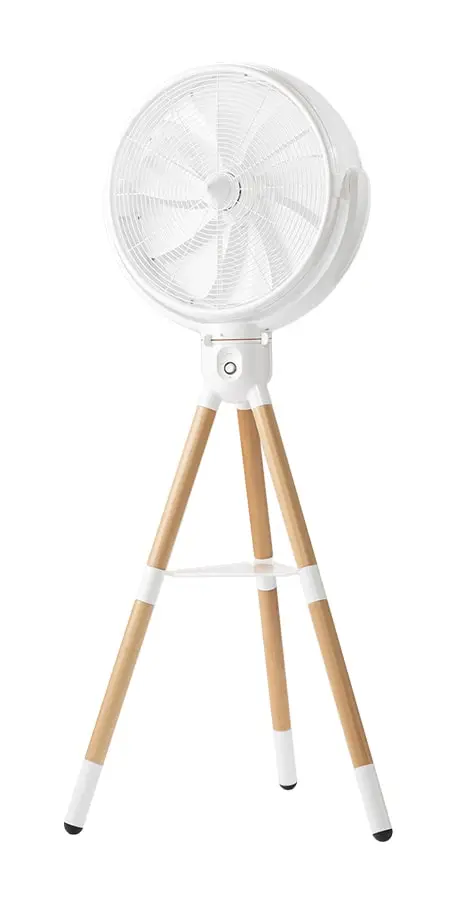
Crafted from steel, beech wood, and polycarbonate and assembled with screws, Williwaw ensures exceptional durability.
Every component is replaceable, the removable blades are dishwasher-safe, and mechanical parts come with a 10-year warranty.
The Williwaw, both an ecological fan and destratifier, combines performance, silence, aesthetics, and longevity, winning over every user.
Williwaw’s 9-blade design produces a sound level 2 to 3 times lower than its competitors, providing a silent solution for hot nights.
Noise level (according to EN60704-2-7 standard):
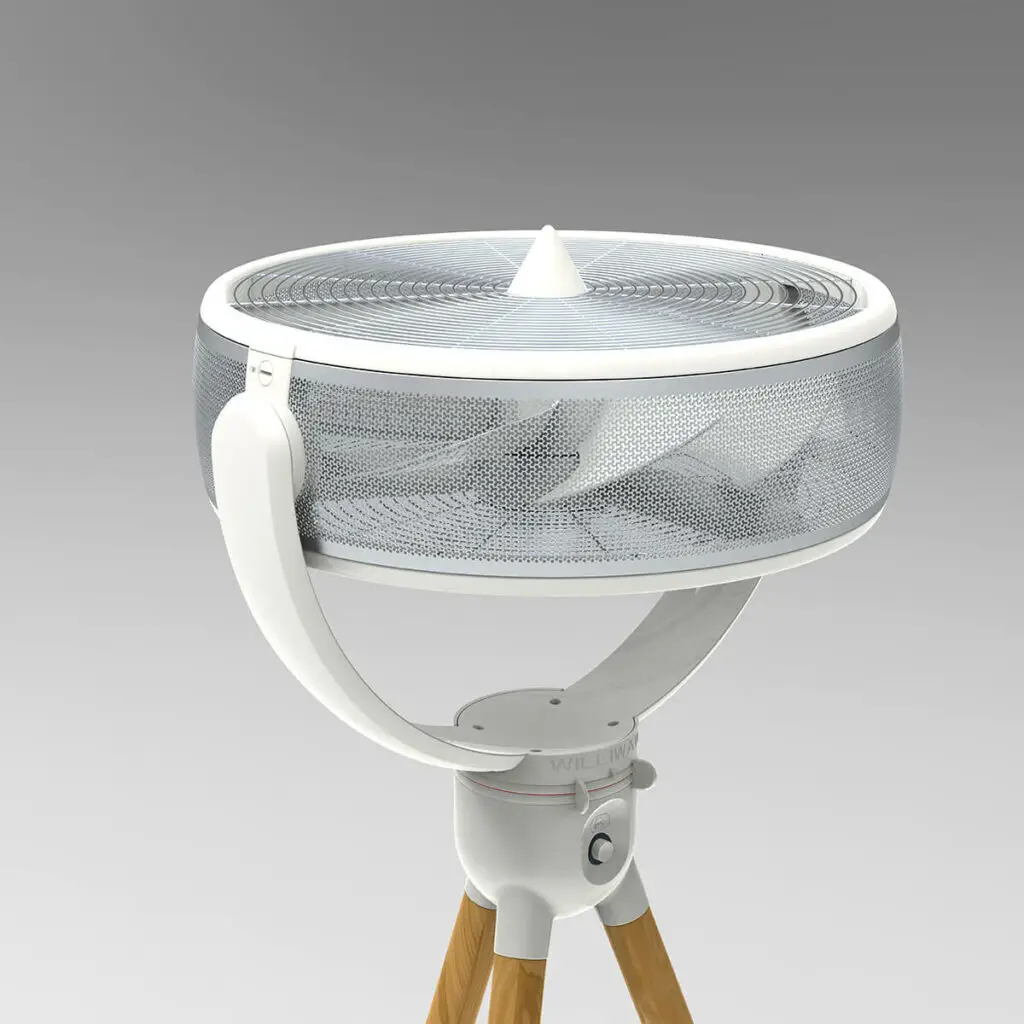
Equipped with a pivoting head and temperature sensors, Williwaw ensures silent convection, triggered automatically by temperature differences between the floor and ceiling. This reduces heating costs by up to 30% where it is installed.
A significant impact, considering that 78% of household CO2 emissions come from heating.
Your phone is the remote.
Williwaw adjusts to your preferences with a variety of airflow settings, from a light breeze to a strong wind. With adjustable oscillation from 45 to 270 degrees and three speeds, it offers a fully customizable experience.
This smart destratifier fan is controlled via a dedicated mobile app, compatible with iOS and Android.
It allows for remote adjustment of its wide, slow, soft, and enveloping airflow for optimal comfort without the annoyance—say goodbye to flying papers!
By regulating temperature, Williwaw eliminates excessive hot or cold spots, increasing comfort in open spaces, conference rooms, and offices.
Even at full power, its powerful motor will not disturb occupants who need to concentrate. They can simply enjoy the pleasant ambient air.
How is this possible? It all comes down to the design and choice of materials.
Furthermore, in the event of a failure, the circuit board is replaced at cost price thanks to a connector system that avoids soldering, making repairs easy.
2 possible heights to choose from before assembly, depending on the number of leg segments used:
What else?
No clipping, no gluing, no welding. 115 screws ensure robustness and allow for complete repairability.
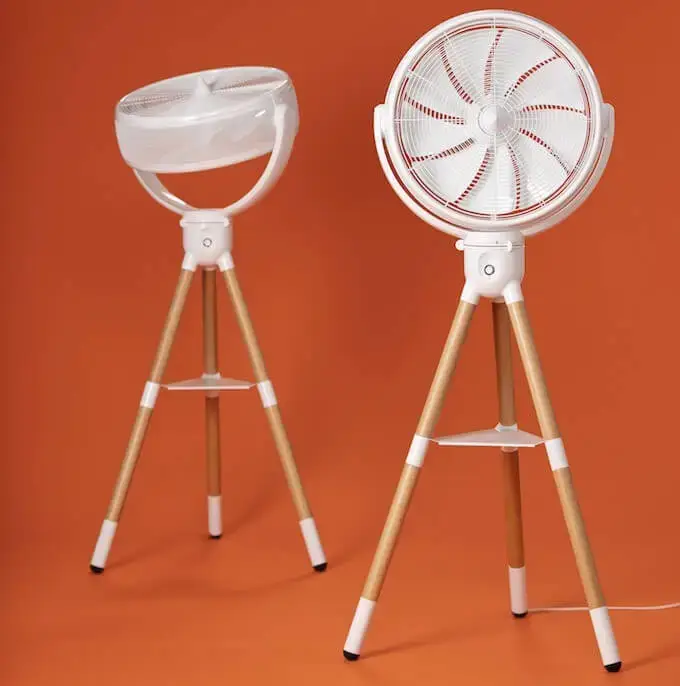
A Williwaw projects its airflow up to 8.5 meters (28 ft) and oscillates up to 270 degrees. It covers a total surface area of 170 m2 (1830 sq ft).
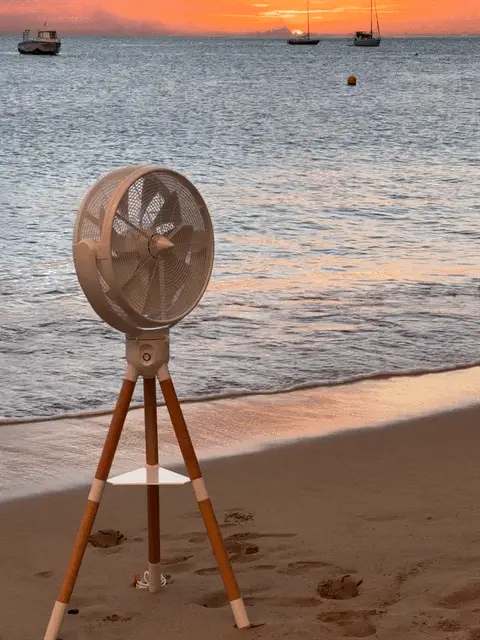
I am Stéphane Thirouin, a designer driven by creating objects that are useful, durable, and aesthetically pleasing.
Faced with a stifling heatwave and determined to avoid air conditioning for ecological reasons, I was unsatisfied with the performance of existing fans. I decided to design Williwaw: a fan that is silent, powerful, energy-efficient, and built to last.

Assembling your Williwaw is a breeze
Henry Grimaud, Journal Les Numériques article du 07/08/22
Assembly is quick and only takes a few minutes.
Summary of assembly steps:
To watch the full video, consult our manual.
Position your Williwaw fan strategically to optimize air circulation throughout the room.
For optimal comfort, ideally place it at a certain distance from walls to allow air to flow freely.
In summer, orient it to create a direct cool breeze toward living areas. For heat distribution in winter, set it to destratification mode near a heat source to circulate the warm air that accumulates at the ceiling.
Placement can vary depending on the season and the layout of your space.
Choosing the ideal fan involves considering several criteria, including power, noise level, and additional features such as timers or oscillation.
However, in a market dominated by brands like Dyson, Rowenta, and Honeywell, Williwaw excels through its discretion, aesthetics, and power.
For effective cooling, check the airflow rate and available speed settings. The price will reflect the technology, features, and product durability.
Silent fans are ideal for working or sleeping undisturbed, with models adjustable in height or orientation ensuring absolute comfort.
To make the air feel colder with a fan, place a container of ice water or ice packs in front of it. The air passing over the ice cools down and helps lower the room temperature, thereby increasing the cooling effect.