A quick note: noise doubles every 3 decibels dB(A) (see our noise/silence article)
Portable single-block air conditioners are very noisy (at least 50 dB(A), equivalent to a running washing machine) because the entire mechanism is inside the room. Split systems have an external unit that handles the loudest and hottest tasks to minimize indoor discomfort.
Be aware that laws often define a “tolerable” threshold for neighbors: adding equipment must not increase noise by more than 5 dB(A) during the day and 3 dB(A) at night (Article R. 1334-33 of the public health code). The noise level of an external AC unit is at least 45 dB(A).
Also, be cautious of manufacturers claiming “noise levels” around 20 dB(A) to suggest near-silence. A closer look at technical sheets reveals this figure often refers to acoustic pressure without further context.
Acoustic pressure is measured at a specific distance, while acoustic power is measured directly on the product.
Therefore, beware of acoustic pressure values that are not associated with a distance.
The only real recommendation is to hear the product in person.
The noise generated by fans varies by “morphology”: the fewer blades a propeller has, the faster it must spin, and the faster it spins, the more audible vibrations it creates. Similarly, a smaller propeller diameter requires higher speeds, increasing noise.
It’s worth noting that so-called “bladeless” fans actually have a small-diameter propeller hidden in the base that spins very fast. This explains the high noise level of these models. You will often find that these manufacturers only compare their noise levels to their own older products.
Grilles and other mechanical supports in the airflow also contribute to noise. Plastic grilles are noisier than metal ones due to their larger surface area; radial grilles are noisier than annular ones because they obstruct the central airflow. Sound power is proportional to the ventilation power; thus, the more speed settings a fan has, the better you can adjust the noise level. Top-performing fans can approach 40 dB(A), while poor models exceed 70 dB(A).
Williwaw is THE silent fan:
At low power, it emits only 33 dB(A), which is imperceptible even in a quiet room—ideal for sleeping or focusing at the office.
At full power, it emits 47 dB(A), making it 4 times quieter than bladeless fans while delivering twice the airflow.
Williwaw’s silent performance is the result of advanced engineering: a 9-blade propeller to reduce rotation speed, a digital motor for precise speed control, spiral grilles to minimize obstruction, and teardrop-shaped optimization on all mechanical supports within the airflow.
To create cold, you unfortunately have to create heat. This heat must be evacuated, either via an external unit or a hose connected to the outside.
Environmentally, the impact on outdoor temperatures is direct:
“If every Parisian household equipped themselves with air conditioning, average electricity consumption during heatwaves would double, increasing street temperatures by 3°C compared to a city with no air conditioning systems.” Environmental Research Letters
Because it acts on the total air mass of the room, an air conditioner has a significant latency period, leading to several issues:
Fixed air conditioners come with many constraints:
Conversely, portable air conditioners require no installation and can be moved, but they still need an external connection. This introduces new constraints:
To create a feeling of coolness, a fan works by increasing air velocity [[see article How a fan cools]]
Fans offer great flexibility: you only need a power outlet to start using one—no installation required.
The effect is immediate and localized, so there is no need to cool the entire house when you are only in one room.
However, fans suffer from several practical drawbacks:
Williwaw combines the strengths of fans while eliminating the flaws of traditional models:
Breaking this layering allows you to recover the heat that stagnates at the ceiling—heat you’ve already paid for—to ensure optimum thermal comfort: this is destratification. [[ link to Destratification ]] Williwaw achieves this with its pivoting head, directing airflow from bottom to top to push warm air down and mix the air layers: this is convection mode.
Among the 6 parameters of thermal comfort, air conditioners target “ambient temperature.” [[read the article on the 6 keys to thermal comfort]] However, this is the most energy-intensive parameter to modify.
Consumption starts at 2500W. A common rule of thumb is to calculate 110W per m2 of room surface, plus 200W per person present.
Air conditioning requires refrigerating all the air in a closed space. The larger the volume, the more energy is needed to cool the people inside.
Due to the time it takes to cool a room, spaces are often air-conditioned while unoccupied to provide immediate comfort upon entry. This is a major source of energy waste.
Furthermore, AC requires a closed space to prevent chilled air from escaping—something that is nearly impossible with portable ACs due to the necessary external vent.
Aware of the energy absurdity of air conditioning, Swiss energy law strictly regulates AC installation for the sake of sustainable development. In some cantons, authorization is required for “comfort” air conditioning, and the criteria are very strict.
Inspectors carry out checks to enforce this law.
With consumption between 5 and 70 Watts, fans are far more energy-efficient than ACs for managing heat peaks. However, conventional motors generate heat and wear, preventing optimum efficiency.
Williwaw is exceptionally energy-efficient: just 5W is enough for a comfortable night’s sleep at 29°C (84°F). At full power, only 48W are needed to create general convection to cool everyone. This is possible thanks to a digital motor without heat buildup or wear parts, paired with a 9-blade propeller, achieving an unrivaled efficiency of 1.28 m3/min/W according to the EN60704-2-7 standard.
NB:
Solutions that reduce the energy consumption of ventilation, heating, and cooling are particularly vital, as these systems currently account for 75% of residential energy consumption in France.
Air conditioning dries out the air, which can weaken mucous membranes (nose, mouth, throat) and leave skin and eyes drier.
Extreme temperature differences between outdoor and indoor air can lead to thermal shock.
Its use is also frequently associated with muscle contractures—reflex contractions that can last for several hours.
AC can be linked to serious pathologies such as Legionnaires’ disease (hundreds of cases observed in France over the last 20 years). Condensation water collects in a tray; if not emptied regularly, it becomes a breeding ground for microbes. This can lead to rapid spread of infections, potentially causing pulmonary issues or respiratory failure in fragile individuals.
During the day, intensive use of a fan too close to the face can cause corneal dryness.
Health risks regarding sleeping with a fan are debated.
A study on optimal sleep conditions by NASA circadian cycle specialist Eryn Flinn Evans concludes that “fans seem useful for sleeping to improve air circulation in the room, for example by preventing pockets of CO2 (…). However, we also found a study showing that many individuals dislike high-intensity airflow on their skin. Based on these results, we recommended that people use a fan to circulate air at night, but that they have the option to direct the airflow in their preferred direction“
Fans can dry out mucous membranes, especially when running continuously and directed straight at you during sleep. Given the principle of evaporative cooling from micro-perspiration [[link How a fan cools]], it is essential, especially for the elderly, to stay hydrated to avoid dehydration.
Because the airflow is wide and gentle, the risk of drying out mucous membranes or the cornea is reduced. Furthermore, Williwaw is the first fan to offer an indirect flow thanks to its pivoting head: you can direct the air toward a wall or ceiling to create a much more diffuse, indirect ventilation.
Globally:
“The 1.6 billion air conditioners installed worldwide generate 10% of global electricity consumption”.
Finding an alternative is urgent.
Locally:
Air conditioners use refrigerants. New-generation fluids are often called “natural,” but they are hydrocarbons; R290 (propane) and R600a (isobutane) are the most common.
The use of these refrigerants makes air conditioners risky in several ways:
No risks to report for fans; they use no dangerous substances. Operation is purely mechanical, using a motor to spin a propeller.
With Williwaw, the only risk is that you’ll sleep peacefully and save money!
Portable ACs are hard to integrate into a room’s decor with their bulky, wheeled-box design. When not banned by urban planning laws, fixed ACs impose ugly external boxes on building facades. Indoors, their large wall units or diffusion grilles are extremely difficult to blend in.
Lacking any real aesthetic vision, standard fans are often hidden as soon as they are no longer needed.
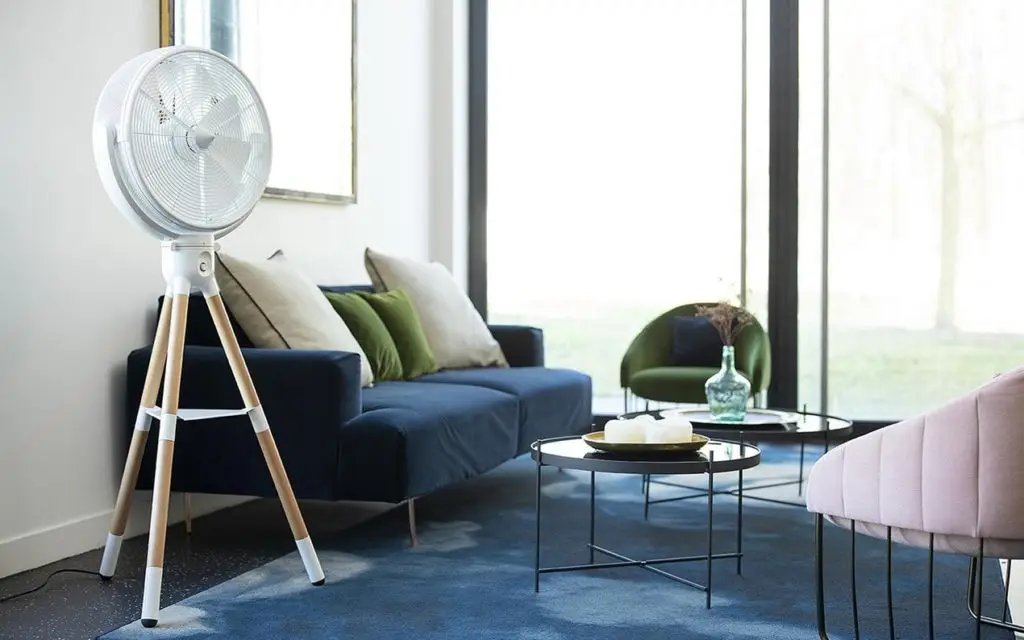
Williwaw was designed to fit into your interior as a piece of furniture. Its Scandinavian-inspired style, subtly blending wood and lacquered white, makes it a timeless object. The simplicity of its form and use hides the technical complexity that ensures its performance—a perfect example of “simplexity.”
[[Link to “Simplexity” article]]
To limit malfunctions and prevent harmful gas leaks, routine maintenance must be performed annually. Regulations often require that this be done by a certified operator. Ideally, AC filters should be cleaned every 2 to 3 weeks.
To ensure proper operation and cleanliness, it is recommended to regularly clean the propeller and the grille.
Maintenance is as easy as possible: the propeller and removable grille are dishwasher safe. Propeller disassembly video
Purchase costs start at €300 for portable units and €900 (excluding specialist installation fees) for fixed units. High-end models quickly exceed €2,000.
Additionally, the average maintenance cost for an AC is over €200 per year, with annual maintenance plans available.
Finally, one must consider electricity costs:
A fan costs from a few dozen euros for entry-level models up to 800 euros for the most high-performing.
There are no maintenance costs and electricity costs are almost negligible.
For an eco-responsible approach, we recommend choosing a robustly designed product and checking warranty conditions.
Silent, useful, durable, powerful, and economical, Williwaw is the credible alternative to air conditioning in summer.
Furthermore, by combining the benefits of convection mode for winter destratification, Williwaw is an investment that pays for itself quickly through energy savings. [[read article on destratification]]
Operating cost comparison: Air Conditioner vs Williwaw:
| Device: | Air Conditioner | Williwaw |
| Power (W): | 2500 | 15 |
| Price per kWh (€): | 0.14 | 0.14 |
| Daily use (h): | 15 | 15 |
| Cost per day: | €5.25 | €0.03 |
| Cost per month: | €157.50 | €0.95 |